Promote your site

0
BOOK BEST
read more
NIE BOOK COLUMNS
Newsbee’s pleased to announce the birth of his newest literacy project, Baby Buzz, a book column for parents, caretakers and teachers of little ones, birth to age 3.Parent educators help Newsbee select one quality picture book each month for the wee ones. Then the child experts write a review which you can feature in your community newspaper. A new Baby Buzz column will be available the 20th of each month.Click HERE for a sample of Baby Buzz. A list of former Baby Buzz type material is available HERE.
The Missouri Press Foundation offers two other monthly book columns available to newspapers at no cost through its Newspapers In Education program. Check out what author Chris Stuckenschneider has ready for your newspaper.Book Buzz and Novel Ideas

* For a complete list of Book Buzz Picks, click HERE.

* For a complete list of Novel Ideas Recommendations, click HERE.
Hello, Friends: Newsbee's the name, reading's my game. Each month, yours truly flits from this book publisher to that, pours over catalogs and talks to those in the know, in schools and libraries, about quality children's books. It's a daunting task, but some bee's got to do it.
From hundreds of titles, I select three each month - preschool through eighth grade - chosen to fit a particular theme. These are my Book Buzz Picks, and each month I announce them in the newspaper. A honey of an idea, don't you think? What better place to introduce kids to good books than on the pages of their local newspaper?
True stories and pretend tales too, I've got them all. But reading them is only half the fun. Newsbee groupies also get to write to me and tell me what they think of my Picks. It's a book club in the newspaper! They'll swarm to see their reviews published in their hometown newspaper. Space, of course, prevents me from running all the reviews I receive, so I just select one for each book.
There are so many ways a newspaper can use my Picks. The word around the hive is that newspapers that have invited me to appear on their pages are mighty glad they did. Be a hero in your hometown - sign up for my monthly Book Buzz Picks through Missouri Press Foundation.
Here's a "Novel Idea." How about giving readers of your community newspaper a heads-up on just-released books? After many requests, the
Washington Missourian is making its popular book column, "Novel Ideas," free to newspapers nationwide. The column has become well-respected by book publishers nationwide. Rather than being a review column, "Novel Ideas" is a book suggestion column. Author Chris Stuckenschneider chooses three books each month to share with readers. The column averages about 600 words per month. The column and cover images, are available for download through the Missouri Press Foundation. To get started publishing "Novel Ideas" in your newspaper, or for further information, contact Stuckenschneider using the information below.
The Missouri Press Foundation offers two other monthly book columns available to newspapers at no cost through its Newspapers In Education program. Check out what author Chris Stuckenschneider has ready for your newspaper.Book Buzz and Novel Ideas

* For a complete list of Book Buzz Picks, click HERE.

* For a complete list of Novel Ideas Recommendations, click HERE.
Hello, Friends: Newsbee's the name, reading's my game. Each month, yours truly flits from this book publisher to that, pours over catalogs and talks to those in the know, in schools and libraries, about quality children's books. It's a daunting task, but some bee's got to do it.
From hundreds of titles, I select three each month - preschool
 through eighth grade - chosen to fit a particular theme. These are my Book Buzz Picks, and each month I announce them in the newspaper. A honey of an idea, don't you think? What better place to introduce kids to good books than on the pages of their local newspaper?
True stories and pretend tales too, I've got them all. But reading them is only half the fun. Newsbee groupies also get to write to me and tell me what they think of my Picks. It's a book club in the newspaper! They'll swarm to see their reviews published in their hometown newspaper. Space, of course, prevents me from running all the reviews I receive, so I just select one for each book.
There are so many ways a newspaper can use my Picks. The word around the hive is that newspapers that have invited me to appear on their pages are mighty glad they did. Be a hero in your hometown - sign up for my monthly Book Buzz Picks through Missouri Press Foundation.
Here's a "Novel Idea." How about giving readers of your community newspaper a heads-up on just-released books? After many requests, the
Washington Missourian is making its popular book column, "Novel Ideas," free to newspapers nationwide. The column has become well-respected by book publishers nationwide. Rather than being a review column, "Novel Ideas" is a book suggestion column. Author Chris Stuckenschneider chooses three books each month to share with readers. The column averages about 600 words per month. The column and cover images, are available for download through the Missouri Press Foundation. To get started publishing "Novel Ideas" in your newspaper, or for further information, contact Stuckenschneider using the information below.
0
BOOK BEST

read more
The novelodeon
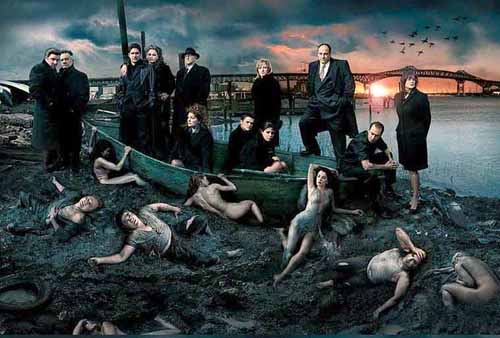
This past April, as the final season of The Sopranos hit the airwaves, with seemingly the whole country bracing for impact, I'd still never seen a single episode. Gradually, my indifference turned to concern. It felt like every talk show, news culture section and conversation on the street was about the fate of Tony Soprano — a latter-day American anti-hero, a titanic figure with the air of myth about him. I began worry that I'd missed out on something big. A cultural touchstone of rare proportions.
So, as the end drew near, I took a deep breath and decided to start from the beginning.
Six months, 86 episodes, and over 70 combined viewing hours later I'm finally done, and while I may have missed out on The Sopranos as a broadcast event — seven seasons of weekly appointments with Tony, Carmela, Meadow, AJ and the whole crumbling world of New Jersey gangsterdom — I got to experience something perhaps more satisfying: a hyper-concentrated, solitary viewing experience, curled up nightly in bed with my laptop. Episodes flowing into each other almost seamlessly like chapters of a book. The pause button like a dog-eared page or bookmark inserted as my eyelids began to droop. An experience not unlike reading a big novel.
Book lovers frequently insist they could never get in bed with a computer, but it seems that this is happening all the time. Any of you who have indulged in a multi-season TV binge can probably attest to this — hours spent prone, the laptop huffing away, plowing through disc after disc (Bob made a similar observation a while back). Substantively too there's something that recalls leisure reading. It has oft been remarked that The Sopranos heralded a major shift in television into terrain once solely occupied by the novel: serial dramas that transcend their episodic structure and become a new kind of literature. Big cross-seasonal plot arcs. A broad social canvas. Intricately interwoven narrative. A large cast of deeply drawn characters. Not to mention a purchase on the country's imagination that recalls the popularity of the great serial fictions of Dickens a century and a half ago. With the spate of high-caliber TV serials originated by HBO and then proliferated by channels across the television spectrum, film has moved onto the novel's turf, matching not only its narrative scope but its expansive dimensions. Stories as big and sprawling as novels can now be told in moving pictures, and thanks to a host of new individualized distribution channels, experienced as intimately, on a laptop or iPod.
Of course I'm not suggesting that film and prose fiction aren't very different things, just that their roles seem to be converging. From its early days, film has been in conversation with the novel, frequently operating on canvases as vast as Anna Karenina or Great Expectations, but it necessarily has had to compress, select and distill the worlds it shows into something in the vicinity of two hours. When a film edges toward the three-hour mark it is considered epic. Simply in terms of duration of story and investment of time by the viewer/reader, movies and novels have always been very different kinds of fiction requiring very different sets of commitments from their audiences.
The shift arguably began with the multi-episode adaptations of classic books pioneered by the BBC in the 70s — shows like I, Claudius, on through the 1995 hit rendition of Pride and Prejudice, right up to last year's Bleak House. Here, television began to stretch out novelistically. And indeed, novels were the source material. Still, the solitary "reading" element was absent here. These were broadcast events, viewed in living rooms at an appointed time set by the channel, with little or no control by the spectator. Soon enough, however, VCRs entered the home and television audiences became time shifters, capturing and bending the broadcasters' schedules to fit their own. From there the die was pretty much cast. A parade of new "narrowcast" technologies — DVDs, TiVo, personal computers, iTunes, bit torrent — imbued these shows with book-like qualities: reader-driven, personal, portable... an intimate cinema of one.
Immediately upon finishing The Sopranos, with the pangs of withdrawal already setting in, I found solace in Wikipedia, which has extensive articles on each episode and character from the show. With the help of the external links, I soon found myself on a strange digital dérive through various arcana: press clippings, blogs, and an forums debating the show's ambiguous ending, personal web pages of supporting cast members such as Joseph R. Gannascoli, who played the gay mobster Vito Spatafore, and from whose site one can purchase such fine collectibles as t-shirts emblazoned with "I Love You Johnny Cakes." Through the drifts of trivia, I eventually dug up several interesting quotes from contemporary authors ruminating on the novel's place in American life and the increasing overlap with television. The first bits were from John Freeman, president of the National Book Critics Circle, who published a piece in The Guardian during those fevered months surrounding the Sopranos finale entitled "Has the novel been murdered by the mob?"From coast to coast, from white-wine sipping yuppies to real life mobsters, The Sopranos has had Americans talking - even those of us not familiar with the difficulty of illegal interstate trucking or how to bury a body in packed snow. While the New York Times called upon Michael Chabon, Elmore Leonard and Michael Connelly to resurrect the serial novel in its Sunday Magazine, critics were calling Chase the Dickens of our time. The final episode roped in some 11.9 million viewers. One major question, though, remains. Has Tony Soprano whacked the American novel?
....America's most powerful myth-making muse long ago moved in to Hollywood (and the White House press room), so the ascendancy of The Sopranos to the level of quasi-literary art should have been expected. Indeed, this wouldn't be troubling were Americans reading other, actual novels. But they're not - at least not in the numbers they once did.
Freeman cites two authors, Gary Shteyngart and the late Norman Mailer, both of whom have discussed The Sopranos as a story of novelistic proportions. First, here's Shteyngart, in a Slate dialogue last year with Walter Kirn:Our time...is more mutable. Change occurs not from year to year but from day to day—the fiction writer's job of remaining relevant has never been harder. And I don't think this will be true only of the present age. I think we are entering a period of unprecedented acceleration, of previously unimaginable technological gain that may be derailed only by the kind of apocalypse found in Cormac McCarthy's latest novel.
The Internet, I both fear and hope, is only the beginning.
But the emotional need to connect with a story remains. One of the folks behind the popular HBO series The Wire recently said that he sees each season as a novel, with a clearly defined beginning, middle, and end. The Sopranos, which may one day be acknowledged as the definitive fiction of the early 21st century, puts an emphasis on detail, setting, and psychology in a way that could resonate with a reader of, say, A Sentimental Education.
And here's Mailer, in a 2004 interview on Poynter Online:The Great American Novel is no longer writable. We can't do what John Dos Passos did. His trilogy on America came as close to the Great American Novel as anyone. You can't cover all of America now. It's too detailed. You couldn't just stick someone in Tampa without knowing about Tampa. You couldn't get away with it. People didn't get upset if you were a little scanty on the details in the past. Now all the details get in the way of an expanse of a novel.
You can take a much broader canvas with nonfiction ... and Americans want large canvases because America is getting so confusing. People want more information than you can get from most novels. You can read a novel about a small subject like the breakup of a marriage, but that's not a wide enough approach for some. It takes something like "The Sopranos," which can loop into a good many aspects of American culture. As I said, I don't think the Great American Novel can be written anymore. There will be great novels ... forever, I hope ... But the notion of a wide canvas may be moving to television with its possibilities of endless hours.
I think it's this element of time that lies at the heart of this over-drawn analogy. The storytellers of television are driving a golden age of magisterial fictions roomy enough to capture the full flow of time. TV serials used to be a way to kill time: repeatable formulas, the same story told again and again, a tradition that's alive and well in shows like Law & Order. You can check in, check out, it doesn't really matter. TV has always been sort of timeless in this way. Whereas prose fiction has long had a special relationship with time. Time, in its fullness, takes time for the author to convey, and the time it takes to read book-length fictions is I think equally part of the reward — it's an endurance sport, long-distance running. I always assumed that only a book could show me the landscape of time in this almost bodily way, but my recent odyssey with the Soprano family appears to have blurred the usual distinctions.
0
BOOK BEST

read more
Novel : The Number 23

Are you a novel reader? did you ever read a novel that it's story somehow connected to you? well... this is what happen to Walter Sparrow (Jim Carrey). One day at his birthday, Agatha (Jim Carrey's wife) bought him a novel book as a birthday present. The book titled The Number 23. As he read the book, he find some odd similarities related to his life. Because of this odd similarities Walter became obsessed to the number 23. He found out that many aspect of his life is related to that number. This movie is directed by Joel Schumacher
0
BOOK BEST

read more
Smiley Book

SmileyBooks
Enlighten. Encourage. Empower.
Publisher:Tavis SmileyPresident:Cheryl Woodruff
Founded by media pioneer Tavis Smiley in 2004 as a co-publishing venture with Hay House Inc., SmileyBooks is a general trade book publisher that specializes in quality nonfiction.
A dynamic company dedicated to the new media landscape, SmileyBooks will publish books by authors ranging from established New York Times bestsellers to exciting new voices on topics that will appeal to a broad spectrum of readers. SmileyBooks titles will be published in hardcover, trade paperback, and digital media, offering the widest possible readership and exposure.
SmileyBooks’ expanded publishing vision is anchored by the imprint’s 2007 #7 New York Times bestseller, THE COVENANT In Action, a companion volume to the 2006 #1 New York Times bestseller, the Covenant with Black America.
SmileyBooks MissionTo empower our readers to achieve their own personal fulfillment and to become agents of change through the principles of love and service.
A Full-Spectrum PublisherSmileyBooks publishes quality nonfiction works in the following categories:Advocacy, Autobiography, Self-HelpEducation, Memoir, InspirationPolitics, Psychology, Business/FinanceSmileyBooks Celebrates New Authors
The new president of SmileyBooks, Cheryl Woodruff, and a roster of newly-acquired authors were introduced at the LOVE WINS reception in New York City. The celebrated authors whose titles will be published by SmileyBooks include Iyanla Vanzant, Dr. Cornel West, Tom Burrell, and Eleanor Hinton Hoytt of the National Black Women's Health Imperative.
About Our Authors
Read the press release
View a clip of the receptionSubmission Guidelines
SmileyBooks only publishes quality nonfiction at this time. We do not publish fiction, children’s books, poetry, science fiction, fantasy or western genres. Currently, we are accepting proposals for books that will be considered for publication in 2009 and beyond. All manuscripts must be submitted via mail. We are unable to accept or respond to e-mail submissions.
Please read the submission guidelines below carefully before submitting any materials. Be sure to include the following:Cover letter giving a brief description of the project and what is included in the submission package. Book proposal, including outline, introduction, table of contents and text/sample chapters approximately 30-40 pages in length. All manuscript proposal materials must be submitted on standard 8-1/2” x 11” paper, in 12-point font. Market analysis of the potential readership for the book, including title, publisher and publication date of all similar books, with an explanation of how your book differs from each example. Author biography that includes publishing credits and credentials in the field. A SASE for return of the proposal. Please note: a self-addressed stamped envelope (SASE) is required. Be sure to include sufficient postage for the materials you want returned. There will be no response of any kind without an SASE.
Langganan:
Postingan (Atom)


